AOWEISI
AOWEISI SKIN

Biological Material · Skin Management

AOWEISI SKIN

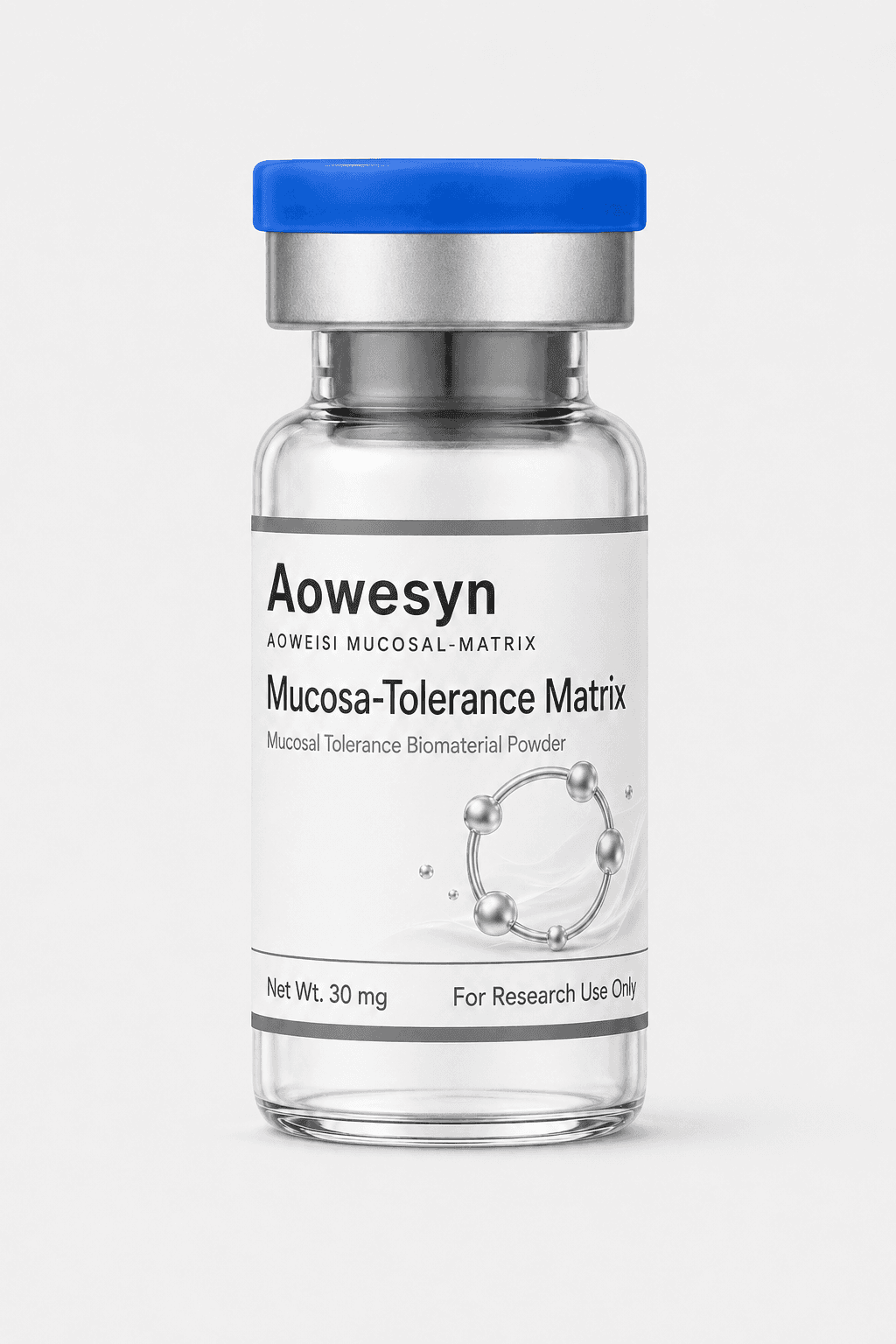
Mucosa-Tolerance Matrix

Not conventional nasal care, but a biomaterial system for respiratory-mucosal immune homeostasis and trans-barrier research.

Reference price: $220.00 / box

Buy Now

DiscountQuantityPrice
0%1 - 4$220.00
8% Off5 - 9$202.00
15% Off10 - 24$187.00
22% Off25+$172.00

Current Price

$220.00

/ set

Total: $220.00

1
SKUMUCOSA_TOLERANCE_MATRIXCategoryIntimate Care

Detailed Information

Vial spec

30 mg · lyophilized powder · Appearance: white to off-white cake

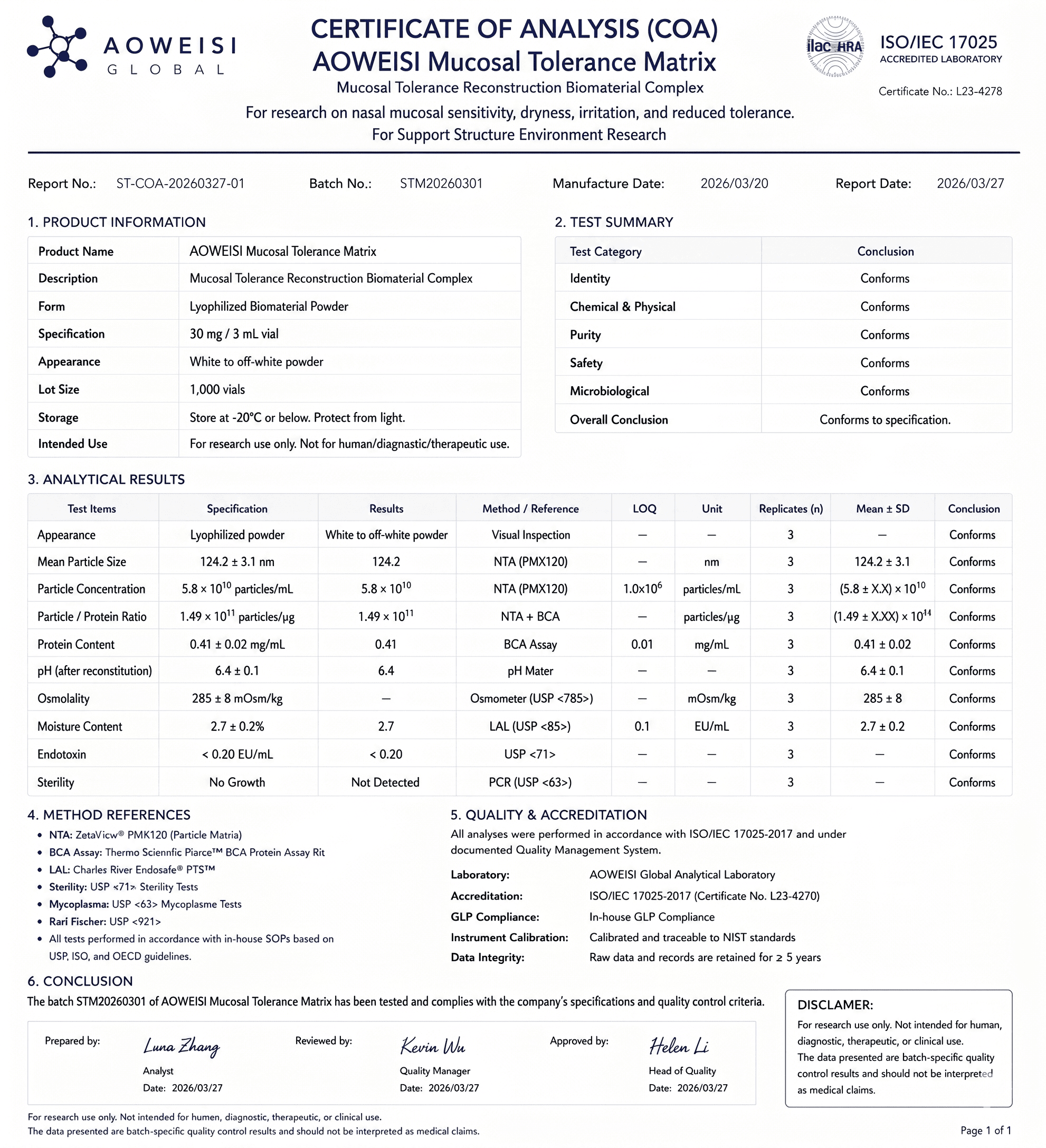
COA

No. MTM-COA-20260327-01 · Lot MTM20260301 · Mfg Mar 20, 2026 · Issued Mar 27, 2026

Size / concentration

Mean size 124.2 nm (spec 100–150 nm) · ~5.8×10¹⁰ particles/mL · Ratio 1.49×10¹¹ particles/µg

Protein / pH

Protein 0.41 mg/mL · pH (1 mg/mL) 6.4 (spec 6.0–7.5) · Moisture 2.7%

Endotoxin / metals

Endotoxin < 0.25 EU/mL · Pb/As < 0.02 ppm (spec ≤ 0.05 ppm)

Sterility / mycoplasma

Sterility: no growth · Mycoplasma: not detected · Residual solvents per USP · Conforms (ISO/IEC 17025, L23-4278)

Lab test image

Product Quality Confirmation Report

Confirms this batch's appearance, specifications, key components, physicochemical indicators and quality standards, ensuring the product meets release quality requirements.

Comparative Mapping

Product Differential Comparison Database

Shows product-specific differences versus traditional categories, including traditional logic, limitations, AOWEISI logic, and key differentiation.

Traditional Research Route

Traditional Research Route

Saline nasal sprays, moisturizing nasal mists, nasal care solutions, nasal-soothing products.

Traditional Research Logic

Conventional nasal care is mostly centered on cleansing, moisturizing, rinsing and soothing—aimed at improving surface dryness, tightness, discomfort or post-trigger states so the nose feels somewhat better in the moment.

Traditional Research Limitations

Conventional thinking mostly stays at physical cleansing and surface moisturizing. It often lacks a systematic framework for why the nasal mucosa keeps becoming sensitive, why discomfort comes up after dry air, dust, odors or environmental change, and how nasal mucosal barrier, external-trigger response and tolerance homeostasis interrelate.

Biomaterial Research Route

Research Direction of This Biomaterial

Focuses on the sensitivity, discomfort and state swings that appear after dry air, dust, odors, seasonal shifts and environmental changes—studying the interplay among nasal mucosal barrier, external-trigger response, low-reactivity state and tolerance homeostasis, to help the nasal area maintain a more stable and comfortable daily microenvironment. Building on AOWEISI's T-cell-derived immune-regulatory signals combined with synthetic biology exosome nasal-spray research, the framework explores a more systematic nasal mucosal care logic.

Core Research Difference

Traditional nasal care mostly stays at 'a quick rinse, a bit of moisture, a momentary relief'; AOWEISI focuses on why the nasal mucosa keeps becoming sensitive, why discomfort follows seasonal shifts, dry air or external stimuli, and how a more systematic biomaterial care approach can help the nasal mucosa stay more stable and lower-burden every day.

Research Mechanism Keywords

Nasal mucosal microenvironment, barrier homeostasis, external-trigger response, tolerance homeostasis, low-reactivity state, daily nasal care.

All content above is based on in vitro research, preclinical research, and biomaterial mechanism research, and does not constitute any promise of disease diagnosis, treatment, cure, prevention, or human clinical efficacy.

Everyday comfort and protective context

Gentle steady state and comfort migration

Gentle homeostasis and comfort migration

Mechanism pathway

Focuses on the tightness, itch, dryness and recurring discomfort that appear after seasonal shifts, dry air, temperature swings, dusty environments or frequent external stimuli. The work is not about briefly 'pushing down sensation' but about nasal microenvironment stability, local comfort and a low-reactivity state—observing how the nose shifts from an easily fluctuating state toward a steadier, gentler daily comfort.

Suitable states

  • Suited for those with dryness, tightness, slight discomfort after seasonal change, AC environments, dry air or external triggers, who need everyday stabilizing care.
Th2TregMicroenv. homeostasisComfort migration
Soft return of sensitivity after external triggers

Gentle return of stimulus threshold

Mechanism pathway

Focuses on why the nose becomes more 'easily triggered' after cold wind, odor, dust, perfume or environmental change. Around shifts in local response threshold after stimuli, the work studies how to keep a more orderly comfort response rather than staying in a 'easily upset by any stimulus' state—understanding why sensitivity rises and how to support a calmer, steadier coping rhythm.

Suitable states

  • Suited for those with easy nasal sensitivity, marked comfort swings after cold wind, dust, scents or air changes, and who want long-term tolerance management.
NALTThreshold ResetExternal-trigger responseTolerance modulation
Mucosal barrier comfort and surface order

Mucosal-barrier comfort support

Mechanism pathway

Focuses on how the nasal surface state and water balance affect comfort. Around barrier integrity, surface suppleness and a local low-burden environment, it observes why the nose feels dry, scratchy, tight and less smooth after dryness, frequent cleansing or environmental triggers. Rather than emphasizing 'instant repair', it supports a softer, steadier, more comfortable barrier state.

Suitable states

  • Suited for those with nasal dryness, heightened discomfort in cold/dry air, daily concern for suppleness and comfort, and a preference for gentle barrier care.
Tight JunctionBarrierMucosal moistureBarrier homeostasis
Soft response to scent and cold-air sensitivity

Gentle response to odor and cold-wind sensitivity

Mechanism pathway

Focuses on people who experience pronounced discomfort with spicy, fragrant, cold-air or wind exposure. Around amplified sensory stimulus, elevated local response and reduced comfort, the work studies how the nose can maintain a softer, lower-burden response to external sensory cues—not 'suppressing sensation', but supporting steadier perception and comfort.

Suitable states

  • Suited for those with sensitive discomfort and reduced comfort after fragrance, spicy odors, cold wind or temperature change, who seek better daily sensory tolerance.
Neuro-ImmuneLow ReactivityPerception modulationComfortable response
Long-term nasal comfort with coordinated dimensions

Long-term comfort and synergistic guarding

Mechanism pathway

Takes a longer-term view of how nasal comfort is maintained. Around the synergy among nasal microenvironment, mucosal barrier, external-trigger response and low-reactivity state, it observes why the nose keeps fluctuating over time and how to support a steadier, more relaxed daily comfort rhythm. The focus is not only on present comfort but on whether the nose can build a more lasting tolerance and synergistic guarding.

Suitable states

  • Suited for those with recurrently fluctuating nasal states, frequent swings across seasons or daily environments, who value long-term comfort management and daily microenvironment care.
Immune ToleranceHomeostasisLong-term homeostasisSynergistic guarding

8 product functions & the issues they address

Plain-language framing
FunctionIssues addressed
01Dry-tight reliefDryness, tightness, slight itch, discomfort post-cleansing
02Low-burden steady careEasily fluctuating state, discomfort after external triggers
03Sensitive-stimulus calmDiscomfort after perfume, dust or cold air
04Deep-nasal freshnessDeep nasal stuffiness, dryness, tightness, restricted breath
05Seasonal stability careInstability after season shifts, dryness or temp changes
06Mucosal supple companionshipLong-term needs, easy nasal dryness, gentle care preference
07Odor/cold-wind calmingSensitivity to cold wind, spicy or strong scents
08Particulate comfort guardPost-commute, dust, smog—nasal grit and itch
Research framing
Research targetPrimary action direction
Surface hydration and barrier comfortSupport a supple, comfortable, low-stimulus nasal state
Nasal microenvironment stabilityReduce swings and keep daily nasal comfort
Gentle response after external triggersHelp the nose return to a steady state faster
Deep-nasal hydration and comfort rhythmHelp keep a fresh, smooth, comfortable feel
Nasal state across seasonal changeSupport low-fluctuation comfort through season shifts
Mucosal-surface supple and tolerance environmentKeep a long-term gentle and supple nasal care state
Sensitivity response to odors and cold windLower stimulus feel and improve comfort acceptance
Surface environment after particulate exposureKeep nasal freshness; reduce dryness and grit feel
R&D logic keywords
Nasal Barrier Comfort Support
Microenvironment Homeostasis Management
Irritation Response Threshold Modulation
Hydration Rhythm Support
Mucosal Comfort & Tolerance Support
Particle-environment Buffer Support

Sensitive nose and tolerance: eight comfort-forward scenes

Scenario 1 | Soothing care when the nose feels dry and tight
Soothing care when the nose feels dry and tight

· Suitable states

Suited for those prone to dryness, tightness or slight itch after season shifts, AC rooms or cleansing.

· Core focus

Focuses on surface hydration and comfort to help the nose maintain a gentle, steady daily state.

· What you might notice

Dryness/tightness may ease; spray contact feels more acceptable; the nose feels softer overall.

Research statement

  • Support a hydrated surface environment
  • Maintain barrier comfort
  • Reduce tightness from dryness

Individual experiences vary; not a promise of fixed outcomes.

Scenario 2 | Soothing care when the nasal state shifts with environment
Soothing care when the nasal state shifts with environment

· Suitable states

Suited for those whose nasal state shifts with the environment—sometimes dry, sometimes tight, with unstable comfort.

· Core focus

Focuses on microenvironment balance and low-burden care to keep a steadier comfort rhythm.

· What you might notice

Nasal swings may lessen; daily comfort lasts longer; the overall state feels steadier.

Research statement

  • Focus on nasal microenvironment homeostasis
  • Support a low-fluctuation comfort state
  • Help reduce discomfort after environmental change

Individual experiences vary; not a promise of fixed outcomes.

Scenario 3 | Soothing care under specific nasal stimuli
Soothing care under specific nasal stimuli

· Suitable states

Suited for those who feel pronounced nasal discomfort after perfume, dust or cold air.

· Core focus

Focuses on gentle response to external stimuli to reduce tension and discomfort.

· What you might notice

After a stimulus, returning to a steady feel is easier; subjective discomfort may lessen.

Research statement

  • Modulate the stimulus-response threshold
  • Support a surface buffering environment
  • Help keep low-stimulus, low-fluctuation states

Individual experiences vary; not a promise of fixed outcomes.

Scenario 4 | Soothing care when the deep nasal area feels dry and stuffy
Soothing care when the deep nasal area feels dry and stuffy

· Suitable states

Suited for those whose deep nasal area feels dry, stuffy, tight, or whose breathing feels less fresh.

· Core focus

Focuses on deep-nasal hydration and freshness to help maintain a smoother, more comfortable experience.

· What you might notice

The deep nasal area may feel fresher; dry-stuffy feel while breathing eases more readily.

Research statement

  • Focus on deep-nasal hydration balance
  • Support local comfort rhythm
  • Help improve perception of freshness and flow

Individual experiences vary; not a promise of fixed outcomes.

Scenario 5 | Soothing care during unstable seasonal change
Soothing care during unstable seasonal change

· Suitable states

Suited for those bothered by nasal discomfort across season change (spring/summer, autumn/winter) or under temp/dryness shifts.

· Core focus

Focuses on the stability of surface environment and comfort under seasonal change, to reduce relapses.

· What you might notice

The nasal area may stay softer through seasons; switching environments feels steadier.

Research statement

  • Focus on nasal state under seasonal swings
  • Support a comfortable surface environment
  • Help keep low-fluctuation, stable experiences

Individual experiences vary; not a promise of fixed outcomes.

Scenario 6 | Gentle soothing care for a long-term dry nose
Gentle soothing care for a long-term dry nose

· Suitable states

Suited for those with chronically dry nose preferring gentle daily care and disliking strong-stimulus experiences.

· Core focus

Focuses on a supple, tolerant surface environment to keep long-term gentle, comfortable care.

· What you might notice

Care feels less stimulating; the nose feels more supple; comfort tends to last longer.

Research statement

  • Support a supple mucosal surface environment
  • Maintain a gentle tolerance state
  • Help keep long-term comfortable experience

Individual experiences vary; not a promise of fixed outcomes.

Scenario 7 | Soothing care for nasal odor and cold-wind sensitivity
Soothing care for nasal odor and cold-wind sensitivity

· Suitable states

Suited for those whose nose feels uncomfortable quickly under cold wind, spicy or strong scents.

· Core focus

Focuses on comfortable response to odor and cold wind, helping reduce tension after stimuli.

· What you might notice

Discomfort after stimuli may ease more readily; the nose returns to comfort faster.

Research statement

  • Focus on sensitivity response under odor/cold wind
  • Support a low-burden comfortable response
  • Help keep a soft, steady nasal state

Individual experiences vary; not a promise of fixed outcomes.

Scenario 8 | Soothing care under dust and particulate environments
Soothing care under dust and particulate environments

· Suitable states

Suited for those with grit/itch after commute, dust, smog or dry air.

· Core focus

Focuses on the surface environment after particulate contact to keep a fresh, comfortable, low-burden state.

· What you might notice

Freshness may improve; dry/tight/grit feel eases more readily.

Research statement

  • Focus on surface comfort after particulate exposure
  • Support nasal freshness and hydration balance
  • Help reduce dry-tight and grit-like discomfort

Individual experiences vary; not a promise of fixed outcomes.

This product is a research-use biomaterial sample intended only for in vitro research, materials evaluation, and formulation development reference. Nothing herein constitutes diagnosis, treatment, cure, or prevention of any disease, nor a guarantee of results after consumer use. For clinical, aesthetic-medicine, or dermatologic disease management contexts, follow qualified physician or pharmacist guidance.

Partnership

Discuss Professional Partnership

For material procurement, professional program partnerships, or custom development inquiries, please contact us through our partnership channel.