AOWEISI
AOWEISI SKIN

Biological Material · Skin Management

AOWEISI SKIN

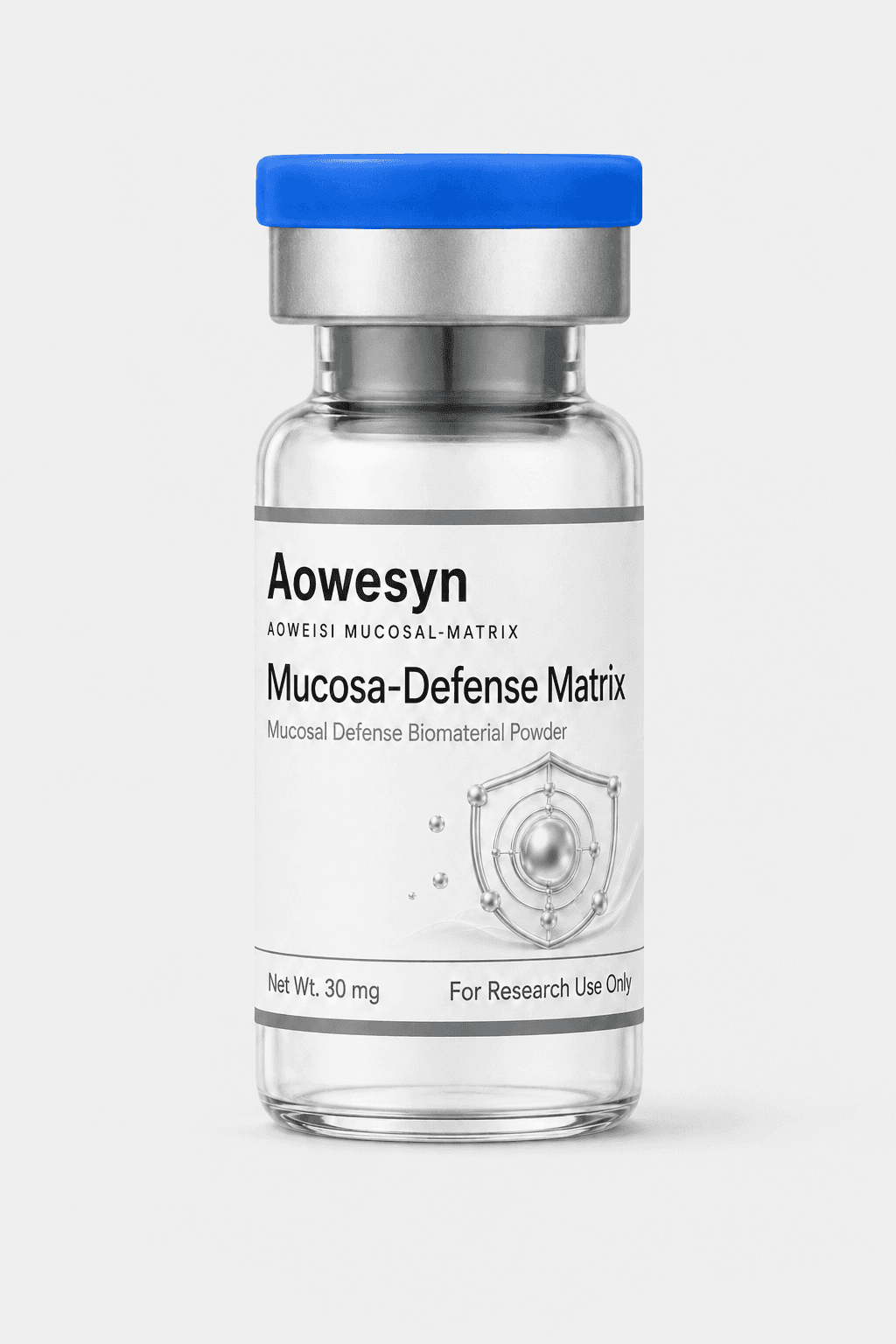
Mucosa-Defense Matrix

Not conventional nasal care, but a biomaterial system for respiratory-mucosal immune homeostasis and trans-barrier research.

Reference price: $220.00 / box

Buy Now

DiscountQuantityPrice
0%1 - 4$220.00
8% Off5 - 9$202.00
15% Off10 - 24$187.00
22% Off25+$172.00

Current Price

$220.00

/ set

Total: $220.00

1
SKUMUCOSA_DEFENSE_MATRIXCategoryIntimate Care

Detailed Information

Vial spec

30 mg · lyophilized powder · Appearance: white to off-white cake

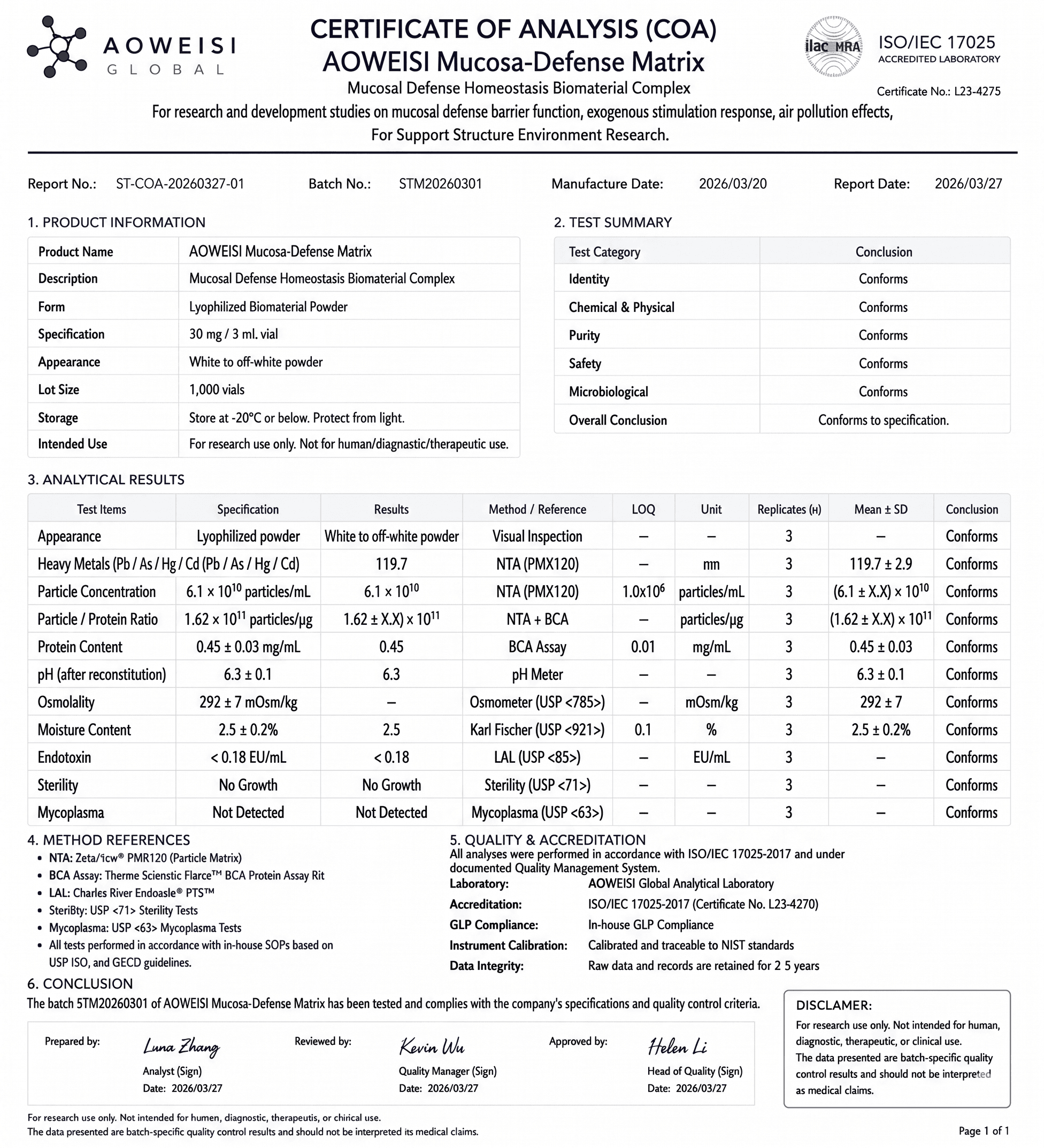
COA

No. MDM-COA-20260327-01 · Lot MDM20260301 · Mfg Mar 20, 2026 · Issued Mar 27, 2026

Size / concentration

Mean size 119.5 nm (spec 100–150 nm) · ~6.1×10¹⁰ particles/mL · Ratio 1.62×10¹¹ particles/µg

Protein / pH

Protein 0.45 mg/mL · pH (1 mg/mL) 6.3 (spec 6.0–7.5) · Moisture 2.5%

Endotoxin / metals

Endotoxin < 0.25 EU/mL · Pb/As < 0.02 ppm (spec ≤ 0.05 ppm)

Sterility / mycoplasma

Sterility: no growth · Mycoplasma: not detected · Residual solvents per USP · Conforms (ISO/IEC 17025, L23-4278)

Lab test image

Product Quality Confirmation Report

Confirms this batch's appearance, specifications, key components, physicochemical indicators and quality standards, ensuring the product meets release quality requirements.

Comparative Mapping

Product Differential Comparison Database

Shows product-specific differences versus traditional categories, including traditional logic, limitations, AOWEISI logic, and key differentiation.

Traditional Research Route

Traditional Research Route

Nasal defense sprays, nasal care solutions, respiratory protection products, barrier-type nasal sprays.

Traditional Research Logic

Traditional nasal protection mostly centers on physical shielding, cleansing rinse, nasal moisturization or reducing contact with external particles—aiming to make the nose feel temporarily more comfortable when stimuli arrive.

Traditional Research Limitations

Conventional thinking mostly stays at 'block, rinse, moisten'. It often lacks a systematic framework for why the nasal mucosa is repeatedly stimulated, why discomfort follows dust, dry air, odors or environmental change, and how nasal-mucosal barrier, defense homeostasis and microenvironment balance interrelate.

Biomaterial Research Route

Research Direction of This Biomaterial

Focuses on the discomfort and state swings after dust, dry air, odors, seasonal shifts and environmental changes—studying the interplay among nasal-mucosal barrier, external microbial pressure, external-trigger response and defense homeostasis, to help the nasal area maintain a more stable and comfortable daily microenvironment. Building on AOWEISI's T-cell-derived immune-regulatory signals combined with synthetic-biology exosome nasal-spray research, the framework explores a more systematic nasal-protection care logic.

Core Research Difference

Traditional nasal protection mostly stays at 'a quick physical block, a rinse, a momentary relief'; AOWEISI focuses on why the nasal mucosa is repeatedly stimulated, why state swings appear after seasonal shifts, dry air or external stimuli, and how a more systematic biomaterial care approach can help the nasal mucosa stay more stable and lower-burden every day.

Research Mechanism Keywords

Nasal mucosal microenvironment, defense homeostasis, external-trigger response, external microbial pressure, barrier homeostasis, low-reactivity state.

All content above is based on in vitro research, preclinical research, and biomaterial mechanism research, and does not constitute any promise of disease diagnosis, treatment, cure, prevention, or human clinical efficacy.

Everyday comfort and protective context

Everyday defense rhythm and comfortable balance

Comfort support for daily defense rhythm

Mechanism pathway

Focuses on the dryness, tightness, reduced freshness and comfort swings that appear after seasonal change, dry air, crowded environments or long indoor work. Not 'strong protection' or 'over-stimulation', but nasal microenvironment, defense rhythm and a low-burden state—helping the nose maintain a gentler, steadier comfort in everyday environments.

Applicable scenarios

  • Suited for daily scenarios with dryness, tightness, reduced freshness after season changes, AC rooms, commuting, offices or crowded settings, and a need for long-term low-burden nasal care.
Host DefenseHomeostasisNasal homeostasisDaily defense
Particle buffering and signal softening

Fresh buffering under particulate exposure

Mechanism pathway

Focuses on the irritation burden on the nasal surface from dust, pollen, particulates, smog or odor environments. Around NF-κB, NLRP3 and related inflammatory signals, the work observes nasal swings under external particles and studies how to reduce over-tension and keep a fresher, calmer surface environment. Not 'fighting stimuli', but supporting a softer buffering and adaptation rhythm.

Applicable scenarios

  • Suited for smog, dust, pollen season, enclosed spaces, commuting or poor air quality, when the nose has dryness, congestion feel, reduced freshness and sensitivity swings.
NF-κBNLRP3Particulate bufferingInflammation reduction
Mucosal hydration and barrier comfort

Hydration rhythm and barrier comfort

Mechanism pathway

Focuses on the link between water balance on the nasal surface and barrier comfort. The nose can feel dry, scratchy, tight or more stinging after dry air, frequent blowing, long AC exposure or over-cleansing. Not just 'moistening a bit', but supporting a softer, steadier daily comfort via mucosal barrier, surface-moisture rhythm and a low-burden microenvironment.

Applicable scenarios

  • Suited for AC rooms, dry/cold weather, long speaking, or after environmental change, when the nose feels dry and tight with reduced comfort and a need for sustained hydration.
BarrierMetabolismHydration rhythmBarrier comfort
Ordered nasal comfort under external pressure

Orderly comfort under external pressure

Mechanism pathway

Focuses on nasal reaction swings under external pressures like cold/hot air, odors, dust, temperature gaps and dry air. Not making the nose 'feel nothing', but observing how the nasal mucosa keeps a more orderly response under external pressure—reducing the highly reactive 'one stimulus = obvious discomfort' state and supporting a steadier, lower-burden comfort.

Applicable scenarios

  • Suited for temperature gaps, fast breathing after exercise, direct AC, strong scents, dry air or commuting outdoors, when the nose is sensitive, dry and uncomfortable.
External StressResponse ControlExternal-trigger responseOrderly comfort
Long-term gentle defensive ecology comfort

Long-term gentle defense ecology

Mechanism pathway

Takes a long-term view of nasal-mucosa stability. Around the synergy between mucosal barrier, microenvironment balance, low-inflammation state and external-trigger response, it observes why the nose keeps fluctuating across seasons, dryness, air-quality shifts or lifestyle changes. Not short-term suppression, but supporting a gentler, more lasting, more stable daily defense ecology.

Applicable scenarios

  • Suited for those with recurrently fluctuating nasal states, long stays in AC rooms or urban commuting, reduced comfort during season change, and a wish for long-term nasal care and microenvironment management.
Low-InflammationMicroenvironmentLong-term homeostasisGentle defense

Keywords: nasal surface environment, everyday protective support, hydration balance, soft response, comfortable steady state. This is a research-use biomaterial for in vitro materials evaluation and information only—not diagnosis, treatment, cure, prevention, or a promise of results in humans.

5 product functions & the issues they address

Plain-language framing
FunctionIssues addressed
01Daily nasal protectionDryness/tightness/slight discomfort after season change, AC, going out
02Particulate fresh bufferGrit/itch after dust, particulates or air pollution
03Mucosal barrier comfortDryness, tightness after cleansing, fragile barrier feel
04High-stimulus stable careDiscomfort after high-pressure environments, dense dust, strong scents
05Long-term gentle careEasy dryness, recurring discomfort, need for daily low-burden care
Research framing
Research targetPrimary action direction
Surface barrier and daily comfortSupport a supple, fresh, low-fluctuation nasal state
Surface environment after particulate exposureHelp reduce grit feel and keep fresh comfort
Mucosal hydration rhythm and barrier stabilitySupport a supple, stable mucosal care state
Response under high-stimulus environmentLower stimulus feel and keep orderly comfort
Long-term gentle care with microbiome balanceKeep a long-term low-burden, stable, comfortable nasal state
R&D logic keywords
Nasal Daily Barrier Support
Mucosal Hydration Rhythm Support
Irritation Response Threshold Modulation
Gentle Microecology Management

Everyday nasal protection: five comfort-forward scenes

Scenario 1 | Soothing care when the nose feels dry and tight in AC rooms
Soothing care when the nose feels dry and tight in AC rooms

· Suitable states

Suited for those prone to nasal dryness, tightness or slight discomfort after season shifts, AC rooms or commuting outside.

· Core focus

Focuses on surface hydration and barrier comfort to keep a gentle, steady nasal care state in everyday environments.

· What you might notice

Freshness and breathing comfort may improve; the nose stays steadier through environmental changes.

Research statement

  • Support surface barrier comfort
  • Maintain a hydrated, fresh nasal environment
  • Help reduce slight discomfort from daily environments

Individual experiences vary; not a promise of fixed outcomes.

Scenario 2 | Fresh soothing care when the nose feels gritty and itchy
Fresh soothing care when the nose feels gritty and itchy

· Suitable states

Suited for those with grit and itch after commute, outdoors, dusty or low-air-quality environments.

· Core focus

Focuses on the surface environment after particulate contact to keep a fresh, clean, low-burden nasal state.

· What you might notice

Grit feel may ease; dry/itchy tightness eases more readily; overall feels fresher.

Research statement

  • Focus on surface environment after particulate exposure
  • Support nasal freshness and hydration balance
  • Help reduce subjective discomfort after dust stimuli

Individual experiences vary; not a promise of fixed outcomes.

Scenario 3 | Barrier soothing care when the nasal mucosa feels dry, itchy and tight
Barrier soothing care when the nasal mucosa feels dry, itchy and tight

· Suitable states

Suited for those whose nasal mucosa feels dry, tight, itchy or less comfortable after cleansing or in dry environments.

· Core focus

Focuses on nasal-mucosa hydration rhythm and barrier stability to keep the nose supple and comfortable.

· What you might notice

Dry tightness may ease; the nose feels softer; spray feels more acceptable.

Research statement

  • Support nasal-mucosa hydration rhythm
  • Maintain barrier comfort and low-stimulus state
  • Help ease tightness from dryness

Individual experiences vary; not a promise of fixed outcomes.

Scenario 4 | Stable soothing care for the nose under strong stimuli
Stable soothing care for the nose under strong stimuli

· Suitable states

Suited for those who feel pronounced nasal discomfort after dense dust, strong scents, temperature swings or high-pressure environments.

· Core focus

Focuses on buffering capacity under strong stimuli to lower tension and keep an orderly comfortable state.

· What you might notice

Post-stimulus discomfort may ease more readily; the nose returns to a fresh, steady state faster.

Research statement

  • Modulate the stimulus-response threshold
  • Support a surface buffering environment
  • Help keep low-fluctuation, low-stimulus comfort

Individual experiences vary; not a promise of fixed outcomes.

Scenario 5 | Soothing care for nasal microbiome and a comfortable environment
Soothing care for nasal microbiome and a comfortable environment

· Suitable states

Suited for those with chronically dry nose and recurring discomfort, or who want a gentle daily care routine.

· Core focus

Focuses on long-term comfort and microbiome balance to keep a low-burden, supple, stable care rhythm.

· What you might notice

With long-term use, the nose stays more comfortable; dry tightness and recurring discomfort may reduce.

Research statement

  • Focus on nasal microbiome and a comfortable environment
  • Support a gentle, low-burden long-term state
  • Help keep a supple, stable, fresh experience

Individual experiences vary; not a promise of fixed outcomes.

This product is a research-use biomaterial sample intended only for in vitro research, materials evaluation, and formulation development reference. Nothing herein constitutes diagnosis, treatment, cure, or prevention of any disease, nor a guarantee of results after consumer use. For clinical, aesthetic-medicine, or dermatologic disease management contexts, follow qualified physician or pharmacist guidance.

Partnership

Discuss Professional Partnership

For material procurement, professional program partnerships, or custom development inquiries, please contact us through our partnership channel.