AOWEISI
AOWEISI SKIN

Biological Material · Skin Management

AOWEISI SKIN

Dermo-Balance Matrix

Not conventional topical skincare, but a topical biomaterial framework for skin-microenvironment reconstruction.

Reference price: $280.00 / box

Buy Now

DiscountQuantityPrice
0%1 - 4$280.00
8% Off5 - 9$258.00
15% Off10 - 24$238.00
22% Off25+$218.00

Current Price

$280.00

/ set

Total: $280.00

1
SKUDERMO_BALANCE_MATRIXCategoryIntimate Care

Detailed Information

Vial spec

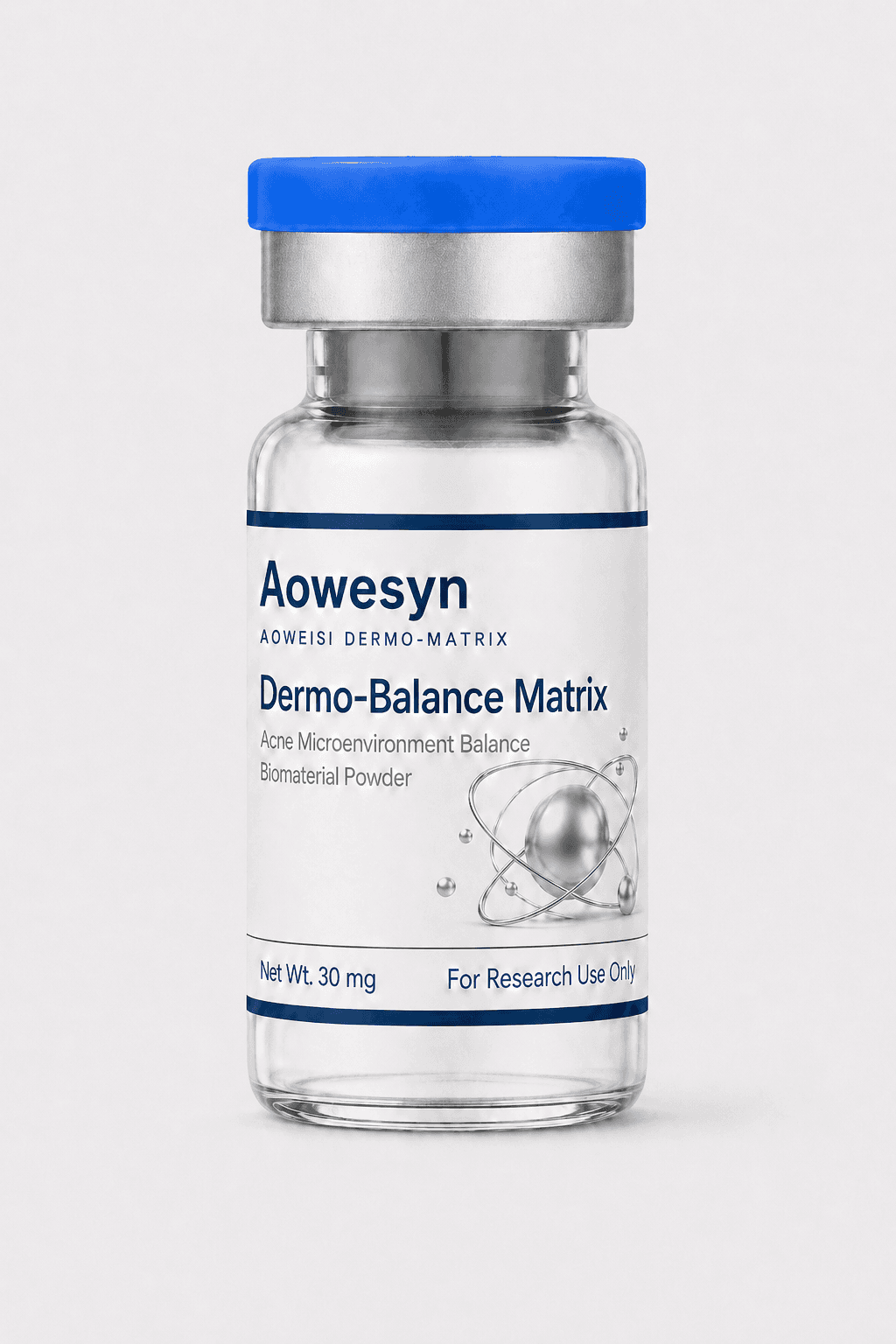
30 mg · lyophilized powder · Appearance: white to off-white cake

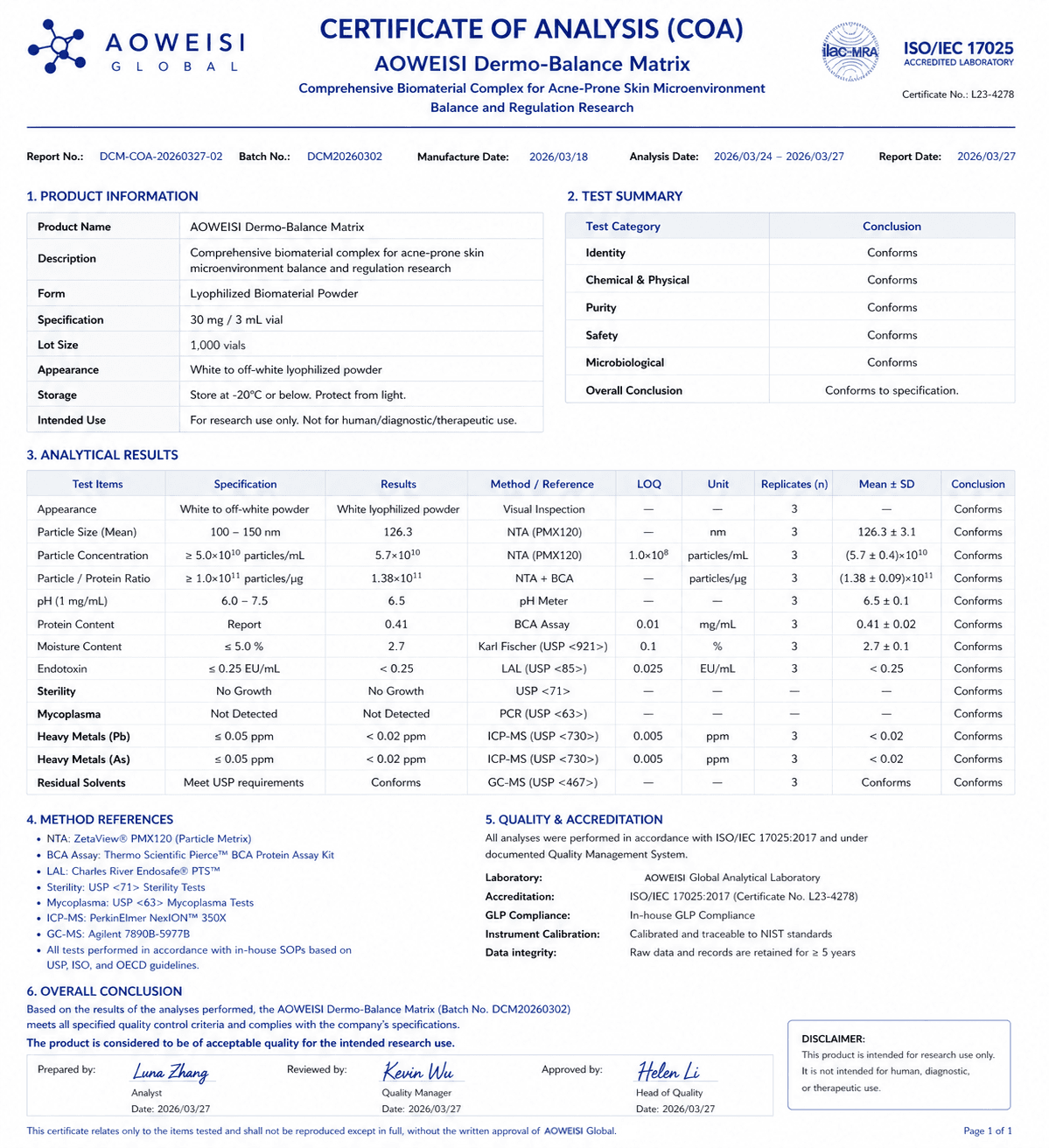
COA

No. DCM-COA-20260327-02 · Lot DCM20260302 · Mfg Mar 18, 2026 · Issued Mar 27, 2026

Size / concentration

Mean size 126.3 nm (spec 100–150 nm) · ~5.7×10¹⁰ particles/mL · Ratio 1.38×10¹¹ particles/µg

Protein / pH

Protein 0.41 mg/mL · pH (1 mg/mL) 6.5 (spec 6.0–7.5) · Moisture 2.7%

Endotoxin / metals

Endotoxin < 0.5 EU/mL · Pb/As < 0.02 ppm (spec ≤ 0.05 ppm)

Sterility / mycoplasma

Sterility: no growth · Mycoplasma: not detected · Residual solvents per USP · Conforms (ISO/IEC 17025, L23-4278)

Lab test image

Product Quality Confirmation Report

Confirms this batch's appearance, specifications, key components, physicochemical indicators and quality standards, ensuring the product meets release quality requirements.

Comparative Mapping

Product Differential Comparison Database

Shows product-specific differences versus traditional categories, including traditional logic, limitations, AOWEISI logic, and key differentiation.

Traditional Research Route

Traditional Research Route

Oil-control acne serums, acid-resurfacing products, anti-acne gels, oily-skin regulation products.

Traditional Research Logic

Mainly centered on salicylic acid, AHAs, azelaic acid, niacinamide, tea tree, oil-absorbing powders or antimicrobial ingredients—focused on oil control, pore clearance, keratin turnover, and localized care.

Traditional Research Limitations

Conventional anti-acne logic tends toward oil control, pore clearance, antimicrobial action and exfoliation, often remaining at surface problem handling with limited integrated framework for the inflammatory microenvironment, oxidative stress, barrier dysregulation, and microbiome pressure behind acne-prone skin.

Biomaterial Research Route

Research Direction of This Biomaterial

Focuses on the often-unstable state of acne-prone skin and the interplay among sebum, pore congestion, barrier dysregulation, external stimuli, and oxidative pressure—researching how to help skin maintain a fresher, more stable daily microenvironment.

Core Research Difference

Traditional acne care mostly stays at 'oil control, pore clearance, localized handling'; AOWEISI focuses on why skin keeps oiling up, getting congested or reddening, and how to help skin stay more stable and lower-burden after late nights, cleansing, diet or environmental changes.

Research Mechanism Keywords

Acne microenvironment, sebum balance, barrier homeostasis, external-trigger response, oxidative stress, inflammation noise reduction, low-inflammation state, microenvironment balance.

All content above is based on in vitro research, preclinical research, and biomaterial mechanism research, and does not constitute any promise of disease diagnosis, treatment, cure, prevention, or human clinical efficacy.

Research mechanisms and applicable scenarios

Illustration: inflammation loop interruption

Inflammation Loop Block

Mechanism pathway

Focuses on acne-prone skin that easily shows redness, congested acne and recurring instability after seasonal shifts, late nights, over-cleansing or external stimuli. By observing NF-κB, NLRP3, IL-1β and related inflammatory signals, the work studies the 'over-response → local discomfort → renewed swings' loop in the microenvironment and helps build a gentler, lower-burden inflammation-signal attenuation approach.

Applicable scenarios

  • Suited for everyday care when acne-prone skin shows noticeable inflammation, easy redness, locally recurring instability, or reduced comfort after external stimuli.
NF-κBNLRP3IL-1βInflammation reduction
Illustration: sebum imbalance management

Sebum Imbalance Management

Mechanism pathway

Focuses on the link between excess oil, pore congestion, sticky touch and unstable barrier states. Rather than 'oil control' alone, it studies how skin maintains a fresher, steadier daily state from sebum rhythm, pore microenvironment, keratin metabolism and lipid oxidation.

Applicable scenarios

  • Suited for care when sebum is high, T-zone or whole face turns oily easily, pores clog, touch turns sticky, and oil swings bring on a congested-acne feel.
SebumPoreLipid oxidationSebum homeostasis
Illustration: oxidative stress control

Oxidative Stress Control

Mechanism pathway

Focuses on acne-prone skin showing dullness, roughness, redness and instability under late nights, stress, UV and air pollution. By observing ROS, NRF2, SIRT1/FOXO3 and related oxidative pathways, the work studies skin's resilience under external triggers and how to keep a low-inflammation state.

Applicable scenarios
  • Suited for care when skin state drops after late nights, external stimuli trigger redness, sebum-oxidation feel is obvious, or acne-prone skin is in a fluctuating period.
ROSNRF2SIRT1/FOXO3Oxidative stress
Illustration: barrier dysregulation support

Barrier Dysregulation Repair

Mechanism pathway

Focuses on tightness, dry itch, redness and reduced tolerance after over-cleansing, frequent acid use, seasonal shifts or external stimuli. Around CLDN1, FLG, KRT14 and related barrier markers, it studies the link between stratum-corneum structure, water retention and barrier defense to support a return to barrier steady state.

Applicable scenarios

  • Suited for care when acne-prone skin's barrier is unstable, feels tight after cleansing/care, reddens easily during seasonal shifts, or shows reduced tolerance.
CLDN1FLGKRT14Barrier homeostasis
Illustration: microecological homeostasis reconstruction

Microbiome Homeostasis Rebuild

Mechanism pathway

Focuses on the interplay between sebum, inflammatory signals, oxidative stress and microbiome balance at the skin surface. Through multi-dimensional observation of skin-flora environment, sebum status and low-inflammation levels, it studies how to reduce external triggers of recurrence and help acne-prone skin keep a cleaner, more comfortable, more stable daily state.

Applicable scenarios

  • Suited for care when acne-prone skin is recurrently unstable, with alternating oiliness and redness, easy swings after external stimuli, and long-term microenvironment management is needed.
Acne microenvironmentSebum managementLow-inflammation stateMicrobiome balance

6 product functions & the issues they address

Plain-language framing
FunctionIssues addressed
01Oily-acne calmEasy oil, breakouts, local redness, recurring instability
02Pore freshness & evennessEnlarged pores, T-zone shine, uneven surface, makeup slide
03Barrier companionshipTightness after cleansing, stinging, fragile barrier, intolerance
04Microbiome comfort orderStuffy feel, oiliness, lack of freshness, easy relapses
05Antiox claritySebum oxidation, dullness, post-acne marks, uneven tone
06Oil-water comfort rhythmInner dry / outer oily, T-zone shine, cheek tightness, more oil-control yields more tightness
Research framing
Research targetPrimary action direction
Focus on low-fluctuation state of oily-acne zonesSupport oily-acne skin in a calm, stable, low-burden state
Focus on sebum secretion and the pore environmentHelp the surface stay clean-feeling and visually even
Focus on stimulus response in fragile barrier periodsLower discomfort during care and improve acceptance
Focus on sebum environment and surface microbiome balanceHelp reduce congestion and keep an orderly fresh feel
Focus on tone under oxidative pressureSupport a clearer tone, reduce dullness and cloudiness
Focus on oil-water rhythm and barrier synergyHelp oily/dry-mix skin return to a more comfortable care rhythm
R&D logic keywords
Sebum Microenvironment Balance
Barrier-friendly Delivery
Sebum-Hydration Rhythm Balance
Skin Homeostasis-oriented Validation

Oily, breakout-prone skin: six care-forward scenarios

Scenario 1 | Soothing care for oily-acne skin with local redness
Soothing care for oily-acne skin with local redness

· Suitable states

Suited for oily-acne skin prone to oiliness, occasional breakouts, local redness or fluctuating states. For daily soothing care.

· Core focus

Focus on comfort, stability and freshness in oily-acne zones to reduce relapses and keep a low-burden care state.

· What you might notice

Local heat, redness and tightness ease more readily; the skin feels fresher, softer and steadier.

Research statement

  • Modulate the oily-acne microenvironment and reduce state swings
  • Support barrier stability and reduce discomfort from external stimuli
  • Maintain a low-burden soothing state to help smooth transitions

Individual experiences vary; not a promise of fixed outcomes.

Scenario 2 | Soothing care for oily-acne skin with uneven surface
Soothing care for oily-acne skin with uneven surface

· Suitable states

Suited for daily care of oily-acne skin with T-zone shine, visible pores, uneven surface, and poor makeup adhesion.

· Core focus

Focus on balancing sebum with the surface environment around pores to keep the skin fresh, breathable and refined.

· What you might notice

Surface oiliness eases; touch is smoother; pore areas look cleaner; makeup sits better.

Research statement

  • Optimize the sebum environment around pores to reduce oily build-up
  • Support surface smoothness and improve refined touch
  • Maintain a fresh, breathable state to reduce congestion

Individual experiences vary; not a promise of fixed outcomes.

Scenario 3 | Soothing care for oily-acne skin feeling tight and itchy
Soothing care for oily-acne skin feeling tight and itchy

· Suitable states

Suited for oily-acne skin that feels tight, stinging, dry or intolerant after cleansing, intensive routines or season changes.

· Core focus

Focus on barrier comfort and care acceptance during fragile periods, reducing stimuli and keeping the skin calm and steady.

· What you might notice

Tightness, stinging and dryness ease more readily; subsequent skincare is better absorbed; touch becomes softer.

Research statement

  • Support barrier function and reduce water loss
  • Modulate the stimulus-response threshold to lower sensitivity signals
  • Calm discomfort during fluctuating periods and improve tolerance

Individual experiences vary; not a promise of fixed outcomes.

Scenario 4 | Soothing care for oily-acne skin under external stimuli
Soothing care for oily-acne skin under external stimuli

· Suitable states

Suited for oily-acne skin that feels oily, congested and not fresh, or whose state easily fluctuates with environment or routine changes.

· Core focus

Focus on stable coexistence of sebum environment and surface microbiome to keep skin fresh, breathable and low-fluctuation.

· What you might notice

Congestion and oiliness lessen; the surface feels fresher; overall touch is cleaner; states are less prone to relapse.

Research statement

  • Focus on surface-microbiome balance to keep an orderly comfortable state
  • Modulate the sebum microenvironment to reduce congestion and heaviness
  • Support a low-fluctuation care state for stable expression

Individual experiences vary; not a promise of fixed outcomes.

Scenario 5 | Soothing care for oily-acne skin prone to oxidative dullness
Soothing care for oily-acne skin prone to oxidative dullness

· Suitable states

Suited for oily-acne skin prone to dullness, cloudy tone, visible post-acne marks after sebum oxidation, or poor complexion after late nights.

· Core focus

Focus on the dullness from sebum oxidation and external stimuli, helping the skin stay clearer, cleaner and steadier.

· What you might notice

Tone reads more even; oily cloudiness reduces; glow appears more natural; the skin feels fresher.

Research statement

  • Counter oxidative pressure to reduce dullness from sebum oxidation
  • Support a clear surface state and improve cloudy appearance
  • Maintain a stable surface environment to show a fresh, clean glow

Individual experiences vary; not a promise of fixed outcomes.

Scenario 6 | Soothing care for oily-acne skin with oil-water imbalance
Soothing care for oily-acne skin with oil-water imbalance

· Suitable states

Suited for oily-acne skin with inner-dry / outer-oily mix, obvious T-zone shine, dry/tight cheeks, or skin that gets drier with more oil-control.

· Core focus

Focus on the rhythm between hydration and sebum—shifting from 'aggressive oil control' to gentler, more comfortable state management.

· What you might notice

Shine is met more gently; tightness lessens; overall feel is more comfortable and the state more balanced.

Research statement

  • Optimize oil-water balance to reduce inner-dry / outer-oily discomfort
  • Support stratum-corneum water reserves and improve suppleness
  • Modulate sebum rhythm to help maintain a comfortable steady state

Individual experiences vary; not a promise of fixed outcomes.

This product is a research-use biomaterial sample intended only for in vitro research, materials evaluation, and formulation development reference. Nothing herein constitutes diagnosis, treatment, cure, or prevention of any disease, nor a guarantee of results after consumer use. For acne, folliculitis, or other dermatologic disease management—or aesthetic-medicine contexts—follow qualified physician or pharmacist guidance.

Partnership

Discuss Professional Partnership

For material procurement, professional program partnerships, or custom development inquiries, please contact us through our partnership channel.